
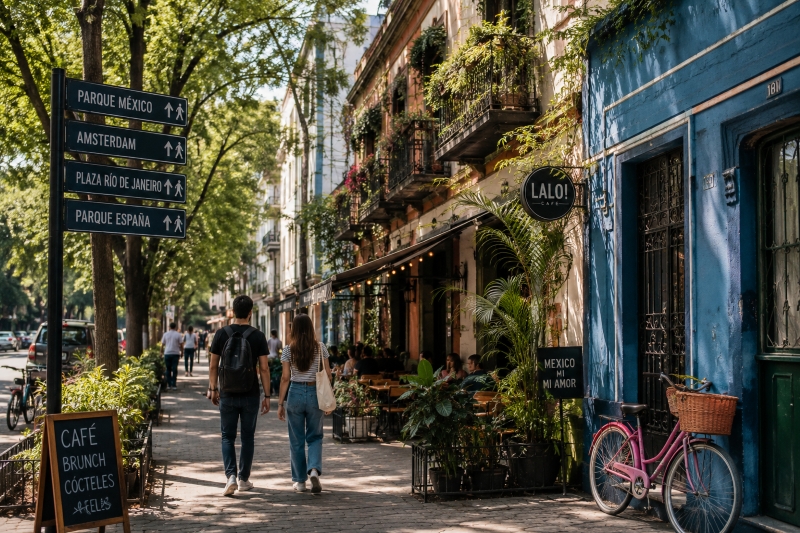
Mexico City is enormous, but that does not mean every day has to be built around long rides across town. Some neighborhoods are especially easy to explore on foot, allowing travelers to move between restaurants, parks, museums, cafés, shops, and local streets without constantly planning transportation.
The key is understanding that walkability in Mexico City is highly local.
Roma Norte, Condesa, Polanco, Juárez, and the Historic Center are all among the best walkable neighborhoods in Mexico City, but they offer very different experiences. Roma Norte works particularly well for food and architecture, Condesa for parks and relaxed walks, Polanco for museums and shopping, Juárez for nightlife and Reforma, and the Historic Center for concentrated sightseeing.
None of them eliminates the need for transportation entirely. Mexico City is too large for that. The smartest approach is to choose a walkable base for the experiences you want most often, then use Metro, Metrobús, or ride-hailing services when you need to move between neighborhoods.
Is Mexico City a Walkable Destination?
Mexico City can be extremely walkable and surprisingly inconvenient at the same time.
Within the right neighborhood, you may spend hours walking without needing a car. Move between neighborhoods, however, and distances increase quickly.
That is why travelers should distinguish between a walkable neighborhood and a completely walkable city.
A useful neighborhood for exploring on foot usually has several characteristics:
Restaurants, cafés, convenience stores, and everyday services are close together.
There are attractions or public spaces worth walking between.
The streets are active enough that walking feels like part of the experience rather than simply transportation.
Public transportation or major avenues are nearby when you need to continue elsewhere.
The neighborhood also needs variety. If you can walk to breakfast but need a 30-minute ride for every museum, dinner, or evening plan, the location may not be as practical as it first appears.
For first-time visitors, choosing the right travel style is often the best starting point. The most walkable neighborhood for a museum-focused trip may be completely different from the best one for restaurants and nightlife.
Roma Norte: Restaurants, Architecture, and Local Life
Roma Norte is one of the easiest neighborhoods to explore without a strict plan.
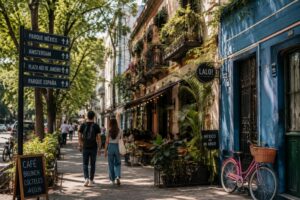
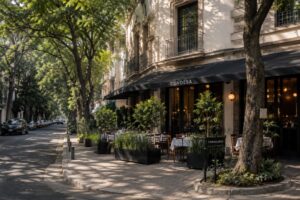
Its appeal comes from density. Restaurants, cafés, bakeries, galleries, bookstores, boutiques, parks, and bars appear along streets that are close enough to connect naturally on foot.
Calle Colima, Córdoba, Orizaba, Álvaro Obregón, and the surrounding residential streets are particularly useful for wandering.
You can start with coffee, continue toward Plaza Río de Janeiro, browse shops along Colima, have lunch, and spend the afternoon moving between galleries without needing transportation.
Architecture adds another reason to walk.
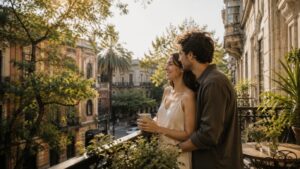
Early twentieth-century buildings, restored houses, decorative façades, balconies, and contemporary design spaces give the streets enough visual interest that the route between destinations becomes part of the experience.
Food is another major advantage.
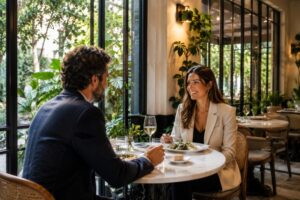
Roma Norte works especially well for travelers who prefer spontaneous meals. You can move from a bakery to tacos, a casual lunch, cocktails, or a more ambitious dinner within the same general area.
The tradeoff is activity.
Some streets remain busy late into the evening, especially around restaurants and bars. That can be ideal if nightlife matters to you but less appealing if you want complete quiet at night.
Best for: food lovers, creative travelers, couples, solo visitors, and travelers who want an active neighborhood with plenty to discover on foot.
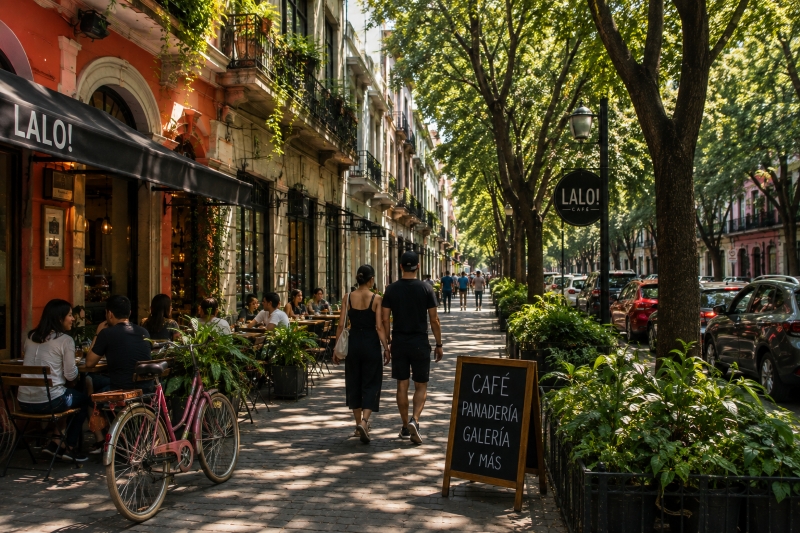
Condesa: Parks and Tree-Lined Streets
Condesa offers a different kind of walkability.
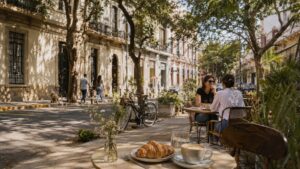
Instead of being driven mainly by galleries and dense restaurant corridors, the neighborhood revolves around parks, wide pedestrian routes, cafés, and residential streets.
Parque México is one of the strongest anchors for walking. Avenida Amsterdam loops around it, creating an easy route lined with restaurants, cafés, residential buildings, and local businesses.
Parque España adds another green space nearby, while the streets between Condesa and Roma Norte make it possible to move between both neighborhoods without treating them as separate excursions.
Condesa works especially well for travelers who enjoy walking without always needing a destination.
A morning can begin with coffee, continue with a loop around Parque México, pause for brunch, and end with an afternoon spent browsing local stores or walking toward Roma Norte.
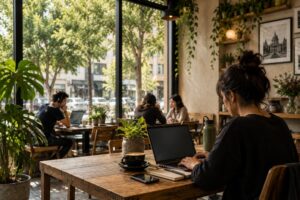
The neighborhood is also convenient for longer stays because everyday services are mixed into the area. Grocery stores, pharmacies, gyms, bakeries, and cafés can all become part of a routine.
If you want to understand how travelers typically move through neighborhoods like Condesa, a few local tips about distances, payments, traffic, and public transportation can make exploring much easier.
Best for: couples, remote workers, longer stays, travelers who like parks, and visitors looking for a slower neighborhood rhythm.
Polanco: Museums, Shopping, and Chapultepec
Polanco is walkable in a more structured way.
The neighborhood has broad avenues, shopping streets, restaurants, museums, hotels, offices, and easy access to Chapultepec.
Avenida Presidente Masaryk is one of the area’s most recognizable routes, while streets such as Horacio and Emilio Castelar connect restaurants, shopping, parks, and residential areas.
For museum-focused travelers, Polanco is particularly practical because Chapultepec sits immediately nearby.
You can spend the morning visiting the National Museum of Anthropology, walk toward lunch in Polanco, and continue to another cultural stop without needing to cross the city.
Museo Jumex and Museo Soumaya also create an easy cultural pairing in the Granada and Nuevo Polanco area.
The neighborhood’s walkability is useful for business travelers too. Many offices, restaurants, hotels, and professional services are relatively close together.
Polanco does feel more polished and commercial than Roma Norte or Condesa, so travelers who want independent cafés and a more bohemian atmosphere may prefer another neighborhood.
Best for: museums, business trips, shopping, families, and travelers who prioritize comfort.
Juárez and Reforma: Central and Well Connected
Juárez is one of the most useful neighborhoods for travelers who want to walk between several different types of experiences.
It sits between Roma Norte and Paseo de la Reforma, giving visitors easy access to restaurants, cafés, nightlife, hotels, offices, and major avenues.
Parts of Juárez feel residential, while others become much more active after dark.
Zona Rosa, which sits within the broader Juárez area, adds bars, restaurants, clubs, and LGBTQ+ nightlife.
Paseo de la Reforma is another major advantage.
The avenue provides a clear walking axis through central Mexico City and connects landmarks, offices, cultural attractions, and transportation.
Juárez is particularly convenient for travelers whose days change frequently. You may walk toward Reforma in the morning, continue toward Chapultepec in the afternoon, and return for dinner or drinks without relying on a car for every segment.
The tradeoff is that pedestrian conditions vary. Some crossings are busy, and wide avenues can make short distances feel less direct than they appear on a map.
Best for: nightlife, short trips, business travelers, and visitors who want central access to multiple neighborhoods.
Historic Center: Landmarks Within Walking Distance
For concentrated sightseeing, the Historic Center is difficult to beat.
Major landmarks are packed into a relatively compact area.
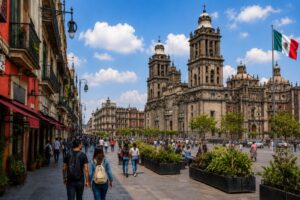
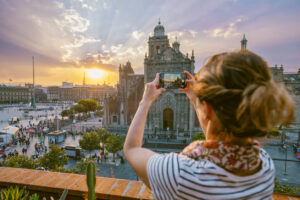
The Zócalo, Metropolitan Cathedral, Palacio Nacional, Templo Mayor, Palacio de Bellas Artes, Alameda Central, and several historic streets can all be connected on foot.
This makes the area especially useful for first-time visitors who want to see major historical attractions without arranging transportation between every stop.
Walking also reveals details that are easy to miss from a vehicle.
Colonial façades, plazas, churches, arcades, street vendors, bookstores, and older commercial buildings turn the neighborhood into a sightseeing experience in itself.
The tradeoff is that the Historic Center can feel much busier and more intense than Condesa or Polanco.
Sidewalks may be crowded, commercial streets become extremely active during the day, and the atmosphere can change quickly between one block and another.
For most travelers, the Historic Center works best as a dedicated sightseeing day rather than the only area they explore during the trip.
Best for: architecture, Mexican history, first-time sightseeing, and travelers who want many landmarks within a compact area.
Best Neighborhood by Travel Style
The best walkable neighborhoods in Mexico City depend on what you want to reach on foot.
If food and cafés are the priority, Roma Norte offers one of the strongest combinations of restaurants, bakeries, galleries, and nightlife.
If you want parks and relaxed walks, Condesa provides an easier rhythm around Parque México, Avenida Amsterdam, and nearby residential streets.
For museums and cultural attractions, Polanco works particularly well because of its proximity to Chapultepec and museums farther north around Plaza Carso.
If nightlife and central connections matter most, Juárez gives you access to Zona Rosa, Reforma, Roma Norte, and multiple transportation options.
For landmark-heavy sightseeing, the Historic Center puts some of the city’s most important historical attractions close together.
No neighborhood is ideal for every category. The goal is to choose the area where you expect to spend the largest part of your trip.
Tips for Exploring Mexico City on Foot
Walking in Mexico City requires a little more awareness than simply following the shortest route on a map.
Start with traffic.
Major intersections can be busy, and drivers may turn through pedestrian crossings. Use marked crossings when possible and pay attention even when you have the right of way.
Sidewalk conditions also vary.
Tree roots, uneven pavement, construction, street vendors, and driveway entrances can make some blocks less smooth than others. Comfortable shoes matter more than travelers often expect.
Altitude is another consideration.
Mexico City sits at more than 2,200 meters above sea level, so visitors arriving from lower elevations may feel tired more quickly during their first few days.
Do not assume that a 30-minute walking route will feel exactly like the same distance at home.
Evening walking requires judgment too.
Busy restaurant streets can remain active late at night, while quieter residential blocks may empty quickly. For longer late-night distances, ride-hailing is often more practical than walking simply because a destination appears nearby.
Combine Walking With Metro, Metrobús, and Ride-Hailing
The easiest way to experience Mexico City is not to choose between walking and transportation.
Use both.
Walk inside neighborhoods and use transportation between them.
Metro and Metrobús can be useful for longer distances, particularly when traffic is heavy. They can also make it possible to stay in one walkable neighborhood while exploring completely different parts of the city.
Ride-hailing services are useful when your route requires multiple transfers, when you are carrying luggage, or when returning late at night.
A practical itinerary might involve walking all morning through Roma Norte, taking transportation to Chapultepec, exploring museums on foot, then using a ride back after dinner.
That combination usually works better than trying to walk unrealistic distances or relying on a car for every short trip.
Stay in a Walkable Neighborhood With ULIV
When walking is one of the main ways you want to experience Mexico City, your accommodation becomes part of the route.
Staying in Condesa can put Parque México, cafés, restaurants, boutiques, and neighboring Roma Norte within easy reach, reducing the number of small daily trips that otherwise require transportation.
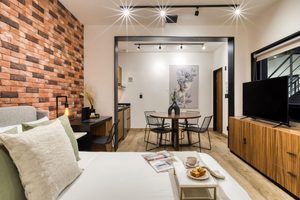
ULIV Condesa is particularly relevant for this type of stay. The property is surrounded by restaurants, bars, cafés, and boutiques and offers different unit formats, including suites, studios, and apartments. Depending on how you travel, that makes it possible to combine a walkable neighborhood with more space than a conventional hotel room.
The value extends beyond the private unit. ULIV Condesa also includes a rooftop with fire pit, gym, business center, and common spaces. For a longer stay, those amenities can help you maintain routines without adding more trips to the day. A rooftop can provide somewhere to slow down after several hours of walking, while the business center can be useful when part of the trip includes remote work.
ULIV also operates through a professionally managed hospitality model rather than functioning as a generic independent rental. Guest attention, professional cleaning, security, and consistent operations add another layer to the stay, particularly for travelers spending several days or weeks in the city.
Explore ULIV Condesa and compare its location with the parks, restaurants, and neighborhoods you expect to walk most often. Choosing the right base can turn walking from a sightseeing activity into part of your everyday Mexico City experience.
Conclusion
The best walkable neighborhoods in Mexico City are not identical, and that is precisely what makes choosing between them useful.
Roma Norte offers food, architecture, galleries, and energetic streets. Condesa provides parks and a slower pedestrian rhythm. Polanco combines museums, shopping, and Chapultepec. Juárez connects nightlife with Reforma and several central districts. The Historic Center concentrates major historical landmarks within a relatively small area.
The smartest approach is not to choose the neighborhood with the highest theoretical walkability.
Choose the one where the things you actually want to do are closest together.
Then use Metro, Metrobús, or ride-hailing to connect the parts of Mexico City that are too far apart to reasonably walk.
With the right base, exploring on foot becomes more than a way to get from one attraction to another. It becomes one of the best ways to notice the architecture, cafés, parks, food, and everyday city life that make each neighborhood feel different.