
Street food is one of the easiest ways to understand Mexico City. Tacos are sliced directly from the trompo, tamales appear on street corners in the morning, quesadillas cook on hot comales, and lunchtime stands fill with office workers ordering dishes they have eaten for years.
For international visitors, though, excitement often comes with a practical question: how do you enjoy all of this without choosing blindly?
Travelers searching for best street food Mexico City safe for expats are usually looking for more than a list of famous taco stands. They want to know how to recognize a busy, well-run vendor, what to order first, how to handle salsa and fresh ingredients, and when it makes sense to be more cautious.
There is no street-food stand that can guarantee you will never feel sick. The useful approach is to reduce risk by paying attention to turnover, temperature, food handling, water, and the behavior of local customers.
Once you understand those signals, street food becomes much easier to approach with confidence.
Why Street Food Matters in Mexico City
Street food is not simply a cheaper alternative to restaurants.
It is part of everyday life.
People stop for tacos before work, grab a tamal on the way to the Metro, eat tacos de guisado during lunch, or finish a night out with something from a grill that is still active after midnight.
Mexico City’s official visitor guide describes street food as an essential part of the city’s food culture and highlights tacos al pastor, tacos de guisado, grilled tacos, tacos de canasta, tamales, tortas, quesadillas, gorditas, sopes, and huaraches among the foods visitors commonly encounter.
That variety means there is no need to try everything on your first afternoon.
If you are new to eating on the street, start with foods you can see being cooked and gradually explore more unfamiliar dishes as you become comfortable with the rhythm of ordering and eating locally.
It is also worth understanding the broader street food scene before building entire days around specific stands. Knowing the difference between a taco de guisado, a taco al pastor, and something cooked on a comal makes ordering far less intimidating.
How to Choose a Stand Like a Local
One of the most useful signals is also one of the easiest to recognize: customers.
A stand with a steady flow of local diners generally has fast ingredient turnover. Meat, tortillas, garnishes, and cooked dishes are more likely to move through the operation instead of sitting for long periods.
Mexico City’s official tourism guidance specifically recommends paying attention to places with plenty of customers and visible demand.
Do not interpret this as a guarantee of safety. Think of it as one useful piece of evidence.
Watch the stand for a minute before ordering.
Are customers arriving continuously? Are ingredients being replenished? Is meat being cooked as orders come in? Are tortillas moving quickly from the griddle to the plate?
A short line can actually be reassuring when it reflects steady turnover rather than poor organization.
It also helps to notice who is eating there. Office workers at lunchtime, neighborhood residents, taxi drivers, delivery workers, and families returning repeatedly can tell you more about a stand than a polished sign or social-media popularity.
What to Look for Before Ordering
Crowds matter, but food handling matters too.
Start with temperature.
Foods such as grilled meat, tacos al pastor, quesadillas, and freshly prepared items from a comal are easier to assess because you can often see them being cooked.
As a general travel-safety principle, food that is thoroughly cooked and served hot is a safer choice than food that has been sitting lukewarm. The CDC similarly recommends choosing foods that are fully cooked and served hot and being more cautious with raw ingredients.
Next, watch how the vendor handles raw and cooked ingredients.
If raw meat is present, utensils and surfaces used for it should not be casually mixed with those used for finished food. Look at whether plates, knives, tongs, and preparation areas appear reasonably organized.
You can also observe hand hygiene and money handling. A small stand will not operate like a restaurant kitchen, but there should still be a basic sense of order.
Pay attention to garnishes as well.
Chopped onion, cilantro, radishes, cucumber, lettuce, and fresh salsa may have been washed or prepared earlier. Travelers who want to be especially cautious can initially focus on hot cooked components and add raw toppings gradually.
The goal is not to inspect every taco stand like a laboratory. It is simply to develop the habit of looking before ordering.
Essential Street Foods to Try First
Some Mexico City foods are particularly approachable for a first street-food experience because their preparation is easy to see.
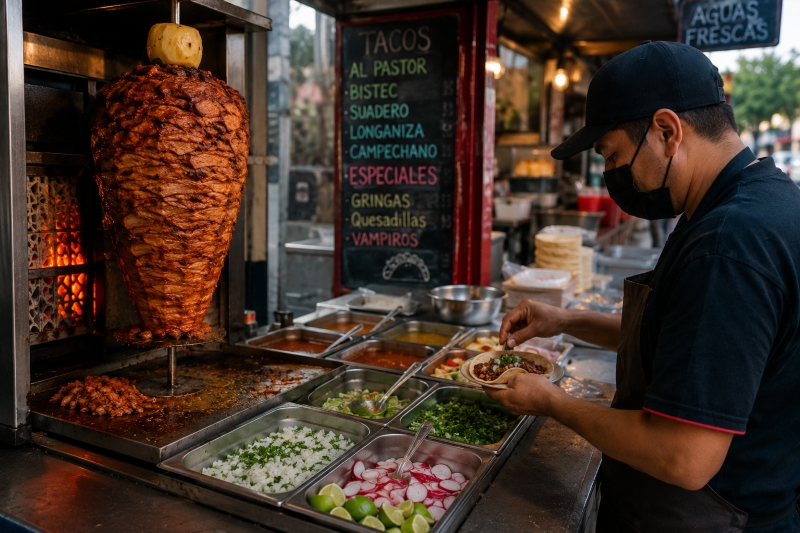
Tacos al Pastor
Al pastor is one of the city’s defining tacos.
Marinated pork is cooked on a vertical spit, sliced into tortillas, and commonly served with onion, cilantro, pineapple, and salsa.
For a cautious first experience, choose a busy stand where the meat is being cut frequently and served hot. You can always ask for fewer toppings until you know what you are comfortable eating.
Grilled Tacos
Tacos de bistec, chorizo, longaniza, or other grilled meats are another straightforward choice.
The advantage for beginners is visibility: you can see the meat going onto the grill and the taco being assembled.
Roma Norte has plenty of established local taco spots, making the neighborhood a convenient place to learn the basics before exploring less familiar parts of the city’s taco culture.
Quesadillas and Tlacoyos
Foods prepared on a hot comal are also easy to understand.
Quesadillas, tlacoyos, gorditas, and sopes often involve masa cooked or reheated directly in front of you. Fillings can range from cheese and mushrooms to squash blossoms, beans, potatoes, or meat.
Remember that in Mexico City, ordering a quesadilla does not automatically mean it will contain cheese. If you want cheese, say “con queso.”
Tamales
Tamales are especially common in the morning.
They are steamed inside corn husks or banana leaves and should be served hot. Start with familiar fillings such as salsa verde, mole, or rajas if you do not want your first experience to involve too many unfamiliar flavors at once.
Tacos de Guisado
Tacos de guisado are filled with prepared dishes such as potatoes, beans, chicharrón in salsa, chicken, eggs, or stewed meats.
They are an important part of everyday lunch culture. Choose busy stands where pots are turning over quickly and the food is being maintained at an appropriate hot temperature.
How to Order and Customize Your Food
Street-food ordering is usually fast and direct, but you do not need perfect Spanish.
At a taco stand, you can simply state the number and type you want:
“Dos de pastor, por favor.”
If you want everything normally included, you may hear or use:
“Con todo.”
For common adjustments:
“Sin cebolla” means without onion.
“Sin cilantro” means without cilantro.
“Sin salsa” means without salsa.
“Con queso” means with cheese.
If you are unsure about how spicy something is, ask:
“¿Pica mucho?”
Many stands have several salsas, and color is not a reliable indicator of heat. A green salsa can be mild or extremely spicy, while a red one can be surprisingly gentle.
Take a small amount first.
It is completely normal to order one or two tacos, eat them, and then order more. You do not have to know your complete order immediately.
Cash is also useful. Some stands accept digital payments or cards, but smaller operations may still be easier to pay in pesos.
Water, Salsa, and Fresh Ingredients
For many travelers, the meat is not the part that deserves the most attention. Water and raw ingredients often require more judgment.
Factory-sealed bottled water is a straightforward choice when you are unsure about the water source. The CDC advises travelers to be cautious with water of uncertain quality and with ice if they cannot verify how it was made.
That does not mean you need to reject every agua fresca or drink with ice in Mexico City.
It means you should ask questions when the source is unclear.
For example, you can ask whether an agua fresca was prepared with purified water or agua de garrafón.
Salsas deserve similar attention because some contain cooked ingredients while others are made with raw tomato, tomatillo, onion, chile, cilantro, or avocado.
If you have just arrived and want to take a more conservative approach, begin with a small quantity or skip raw salsa at stands where you are uncertain about preparation.
The same applies to raw garnishes.
You can enjoy a taco perfectly well without piling on every onion, radish, cucumber, or salsa available.
Best Areas for a First Street-Food Experience
There is excellent street food all over Mexico City. Beginners, however, may feel more comfortable starting in areas where eating can be combined with walking, cafés, restaurants, and other activities.
Roma Norte and Condesa
Roma Norte and Condesa are convenient starting points because food stands coexist with cafés, bakeries, restaurants, parks, and busy pedestrian streets.
You can try one or two tacos rather than committing to an entire street-food itinerary, then continue walking or stop somewhere else.
This makes it easier to introduce unfamiliar foods gradually.
Juárez
Juárez provides another accessible mix of street food, restaurants, bars, and everyday neighborhood activity.
Lunch hours can be particularly useful because stands serving workers tend to have visible turnover.
Centro Histórico
The Historic Center offers a much denser and more traditional street-food environment.
You will find everything from tacos and tortas to snacks and sweets around major pedestrian corridors and markets.
The amount of choice can be overwhelming, so the same rule applies: watch where people are actually eating rather than choosing solely because a stand happens to be closest.
Go Deeper Once You Are Comfortable
After you understand how ordering works, you can explore areas where street food is more central to the experience.
Lorenzo Boturini, for example, is recognized by Mexico City’s official visitor guide for its concentration of taco stands and long-standing late-night taco culture.
There is no prize for starting with the most adventurous option. Build confidence first.
When Travelers Should Be More Cautious
Some people should take a more conservative approach to street food.
Pregnant travelers, young children, older adults, and people with weakened immune systems may face greater consequences from foodborne illness and should consider following stricter food and water precautions.
Travelers who have just recovered from stomach illness should also avoid immediately testing their limits with raw garnishes, seafood, or unfamiliar ingredients.
If something at a stand looks wrong, trust that observation.
You do not owe a vendor an order because you stopped to look at the menu.
Move on.
Mexico City has so much food that there is almost always another busy stand a few minutes away.
Good judgment matters more than completing a list.
Explore Local Food From Your ULIV Base
Street food is easier to enjoy when you do not have to turn every meal into a cross-city expedition.
Staying in a food-focused neighborhood such as Roma Norte lets you try a taco stand at lunch, return to your accommodation for a break, and head out again later without spending large portions of the day in traffic. A few local tips can also make it easier to understand payments, transportation, walking distances, and everyday routines while you explore.
For this kind of trip, ULIV Roma Norte can work as more than a place to sleep. The property offers fully equipped units along with a rooftop, terrace, and outdoor gym, giving travelers additional spaces to relax between meals and neighborhood walks. Those amenities complement the location rather than replacing the reason you came: experiencing the city outside.
There is also a difference between staying in a generic independent rental and having a professionally managed hospitality operation behind the accommodation. ULIV adds guest support and a more consistent stay experience, which can be useful for international travelers balancing exploration with the practical side of being in an unfamiliar city. ULIV’s brand guidelines specifically emphasize hospitality, professional cleaning, guest attention, and amenities as part of that distinction.
If Roma Norte fits the way you want to eat and explore, compare the available options at ULIV Roma Norte and choose a base that keeps neighborhood food, cafés, and city life within easy reach.
Conclusion
Enjoying Mexico City street food safely is not about finding a secret list of stands guaranteed to cause no problems.
It is about learning how to read the scene.
Choose places with visible turnover. Watch whether food is being cooked and served hot. Pay attention to handling, utensils, water, salsa, and raw garnishes. Start with foods that are prepared in front of you, learn a few basic ordering phrases, and introduce unfamiliar dishes at your own pace.
Tacos al pastor, grilled tacos, quesadillas, tlacoyos, tamales, and tacos de guisado all provide approachable ways to begin.
Most importantly, do not let either fear or social-media hype make the decision for you.
The useful answer to best street food Mexico City safe for expats is not one specific taco stand. It is knowing what to look for so you can make better choices wherever the day takes you.
Once those habits become automatic, street food stops feeling like a risk you need to overcome and starts feeling like what it is for millions of people in Mexico City: an ordinary, flavorful part of daily life.