
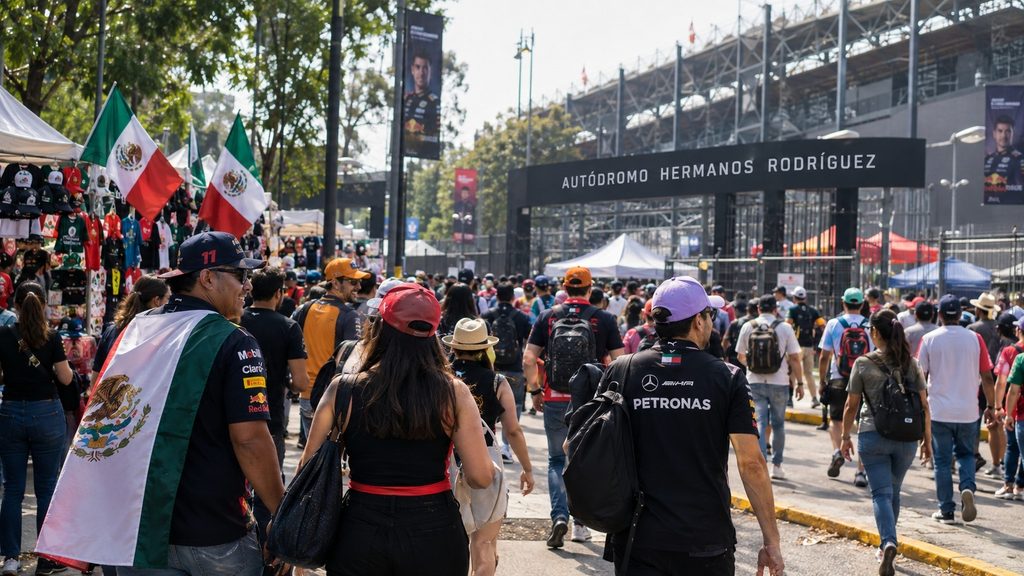
Getting to the Autódromo Hermanos Rodríguez is one of the most important logistics decisions of the Mexico City Grand Prix 2026.
The race weekend runs from October 30 to November 1, with Formula 1 practice on Friday, qualifying on Saturday, and the Grand Prix scheduled for 2:00 PM local time on Sunday.
For an international visitor, however, knowing the schedule is only part of the plan.
Mexico City is large, race-day traffic can be heavy, the circuit has several access gates, and there is no public parking at the venue. The best route depends on where you are staying, which entrance appears on your ticket, and how much walking you are comfortable adding to the day.
If you are researching how to get to Mexico City Grand Prix 2026, the key is to plan both directions before leaving your accommodation: how you will reach the circuit and how you will return once thousands of other spectators are leaving at the same time.
Where Is the Autódromo Hermanos Rodríguez?
The Autódromo Hermanos Rodríguez is located east of the central neighborhoods where many international visitors stay.
It sits within the Ciudad Deportiva Magdalena Mixhuca complex and is connected to the rest of the city by Metro, Metrobús, trolleybus routes, roads, and event-specific transportation options.
That makes the circuit accessible without staying next to it.
Formula 1 itself highlights the venue’s connection to Mexico City’s Metro system, which is one reason travelers can combine the Grand Prix with a stay in neighborhoods such as Roma Norte, Condesa, Juárez, or Reforma rather than treating the race as an isolated trip.
The circuit is also large enough that “Autódromo Hermanos Rodríguez” is not a precise destination on race day.
Your ticket matters.
Different grandstands, hospitality areas, and ticket zones use different entrances, so your route should be planned around the gate assigned to your seat rather than simply around the closest point on a map.
Metro Line 9 Is One of the Main Race-Day Options
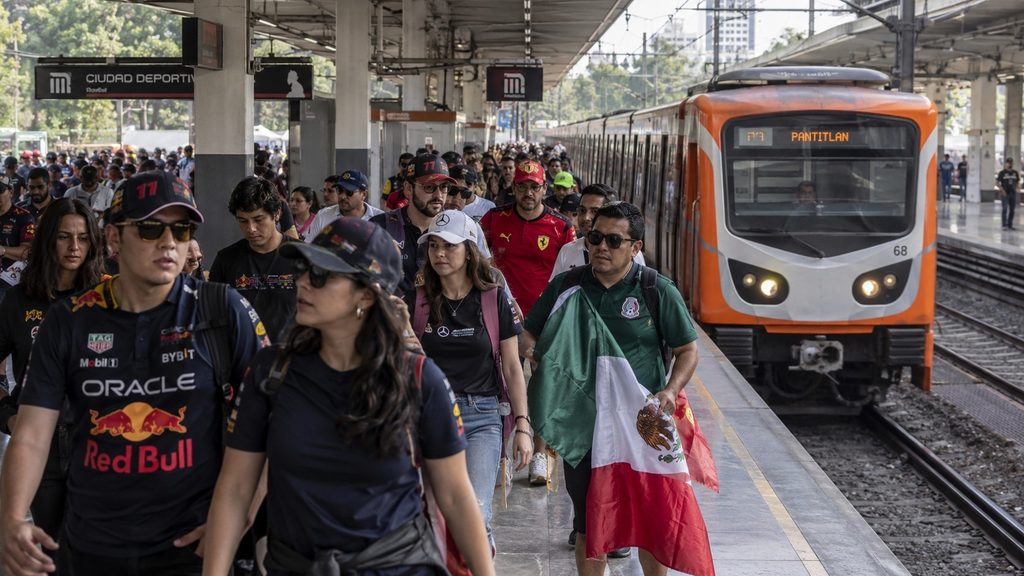
For many visitors, Metro Line 9 is one of the most practical ways to reach the circuit.
Mexico City’s Metro is the city’s rapid-transit system. Line 9 runs across the city from Pantitlán to Tacubaya and passes directly through the area around the Autódromo.
The official Mexico GP information identifies three stations as the main Metro references for the venue:
- Velódromo
- Ciudad Deportiva
- Puebla
All three are on Line 9.
Which one makes the most sense depends on your entrance.
Do not automatically get off at the station that appears closest to the middle of the circuit. A different station may put you closer to the gate assigned to your grandstand and reduce unnecessary walking around the perimeter.
This becomes especially important because spectators cannot simply enter through whichever gate they reach first.
Mexico GP states that access is assigned according to the zone, grandstand, or hospitality product listed on the ticket.
A simple race-day routine is:
- Check the gate on your ticket.
- Match it with the relevant side of the circuit.
- Choose the most practical station.
- Save the route before leaving your accommodation.
- Expect heavier passenger volumes than on a normal day.
If you have not used public transportation in Mexico City before, our Mexico City travel tips can help with broader transportation and city-navigation context before race weekend.
What Is Metrobús and Can You Use It for the Race?
Metrobús is Mexico City’s bus rapid transit system.
Unlike a regular city bus, it uses dedicated corridors and stations along major routes. For the Grand Prix area, the official event information identifies Line 2 as another public transportation option.
UPIICSA and El Rodeo are listed as relevant Metrobús stations for reaching the circuit area.
Metrobús may be useful depending on where your trip begins, but it does not automatically make more sense than Metro.
The best choice is the one that minimizes complicated transfers and unnecessary walking.
For example, a traveler staying near a convenient connection to Line 9 may find Metro much simpler. Someone whose accommodation connects more naturally with Metrobús Line 2 may prefer that route.
For international visitors, it helps to think of Metro and Metrobús as two separate systems that form part of the same broader public transportation network rather than assuming they are interchangeable.
Your Ticket Gate Should Shape the Route
One of the easiest race-day mistakes is navigating only to “Autódromo Hermanos Rodríguez.”
The circuit uses multiple access gates.
The current official access information lists different entrances for the event’s color-coded zones and grandstands, including gates 1, 4, 6, 8, 9, 11, 12, 13, and 14 depending on the ticket area.
You cannot use every entrance with every ticket.
That means two friends attending the same race but sitting in different grandstands may need different arrival routes.
Before race day, keep the following together on your phone:
- Your digital or physical ticket
- Assigned gate
- Metro or Metrobús station you plan to use
- Screenshot of the circuit access map
- Accommodation address
- Backup route
This preparation is much easier than trying to determine the right entrance after arriving at the wrong side of a crowded venue.
Should You Use Uber or Another Ride-Hailing App?
Ride-hailing can be useful during a Mexico City trip, but it requires more flexibility around a major event.
Road congestion increases around the circuit, and vehicle access near the venue can be affected by event operations, crowds, security perimeters, and temporary traffic measures.
That means a ride that works smoothly on a normal evening may take much longer on Grand Prix weekend.
Using ride-hailing for the entire journey may still be appropriate if:
- You are traveling with someone with limited mobility.
- You are carrying items that make public transit difficult.
- Your accommodation requires multiple inconvenient transfers.
- You are leaving at a time when public transportation is less practical.
Another strategy is to combine options.
You might use ride-hailing to reach a Metro station outside the heaviest event congestion, then complete the trip on Line 9.
After the race, the opposite can work: walk away from the busiest perimeter or use public transportation for part of the return before requesting a car.
Do not rely on being picked up immediately outside your gate.
There Is No Public Parking at the Circuit
Travelers renting a car in Mexico City should know that the Autódromo does not provide public event parking.
The official Mexico GP information recommends public transportation or organized transportation options such as Ticket2Ride instead.
This changes the value of having a car during race weekend.
Parking at your accommodation may still be useful if you plan to drive elsewhere during the trip, but it does not mean driving directly to the Grand Prix will be the easiest option.
In previous editions, race organizers and city authorities have also operated remote transportation programs from other parts of Mexico City because there is no public parking at the circuit. The exact race-day transportation plan can change from one edition to another, so travelers should check the official 2026 mobility announcement once it is published rather than assuming previous remote shuttle locations will remain identical.
Getting There Is Easier Than Getting Out
Arriving at the race is only half the transportation plan.
After qualifying and especially after Sunday’s Grand Prix, large numbers of spectators leave within a relatively short period.
Metro stations become busier.
Ride-hailing pickup demand increases.
Traffic around the venue becomes heavier.
Walking routes fill with spectators moving toward different stations and pickup points.
Do not schedule a tight dinner reservation immediately after the race based on the shortest estimated journey shown by a navigation app.
Formula 1 lists the Sunday Grand Prix from 2:00 PM to approximately 4:00 PM, but leaving the grandstand, walking to your exit, reaching transportation, and crossing the city can add considerable time.
The simplest approach is to keep the post-race schedule flexible.
If you want dinner afterward, choose somewhere near your accommodation rather than somewhere that requires another cross-city trip at a fixed time.
Returning to Roma Norte, Condesa, Juárez, and Reforma
Many international visitors stay west of the circuit.
That means the return journey usually involves traveling back toward the central neighborhoods after each day’s sessions.
Roma Norte and Condesa
Roma Norte and Condesa work well as accommodation bases because the race is only one part of the trip.
You can use public transportation to reach the circuit and return to neighborhoods where restaurants, cafés, bars, and everyday services are concentrated.
Depending on the exact property, you may need a Metro connection, ride-hailing for part of the journey, or a combination of both.
The advantage is what happens once you return: dinner and evening plans do not require another long journey.
Juárez and Reforma
Juárez and Reforma also work well for international visitors because they provide central access to several parts of Mexico City.
These areas are especially practical when your trip combines Formula 1 with sightseeing, nightlife, business, or attractions around Chapultepec.
If you are still choosing your accommodation, our guide to where to stay in Mexico City can help you compare neighborhoods according to the rest of your itinerary.
How Early Should You Leave?
There is no single departure time that works for every ticket holder.
Your decision depends on:
- Which day you are attending.
- Which session you want to see.
- Your assigned entrance.
- Your starting neighborhood.
- Your transportation method.
- How familiar you are with Mexico City.
- How much time you want before the first session.
The venue currently lists an approximate opening time of 8:00 AM on event days, although organizers note that this can change.
If this is your first time attending the Mexico City Grand Prix, arriving with extra time is preferable to planning around the minimum possible journey.
A buffer gives you room for crowded stations, finding the correct entrance, security checks, and walking inside the venue.
Remember that there is no re-entry once your ticket has been scanned for the day.
That makes it especially important to arrive with everything you need.
What to Carry for Race-Day Transportation
Race day involves more walking and waiting than a normal sightseeing day.
Keep your setup simple.
Useful items include:
- Fully charged phone
- Portable battery
- Ticket accessible offline
- Screenshot of your assigned gate
- Transportation card or payment method needed for your planned route
- Accommodation address saved offline
- Comfortable walking shoes
- Weather-appropriate clothing
- Only items permitted under the event’s current entry rules
Check the official prohibited-items and security information shortly before attending, since event rules can change.
For public transportation, avoid keeping your ticket, phone, and wallet in one easily accessible place when moving through crowded stations.
The goal is practical preparation, not alarm.
Staying Somewhere With Easier Connections
Transportation should influence where you stay, but it should not be the only criterion.
A property beside the track may reduce one journey while making the rest of the Mexico City trip less convenient.
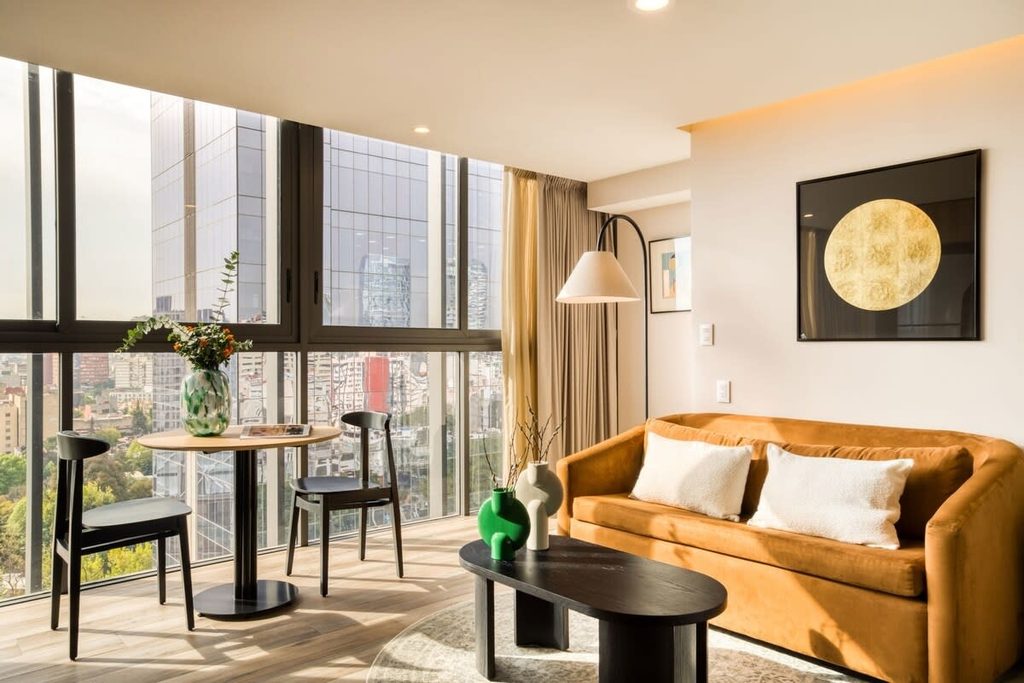
For visitors who want Roma Norte as their base, ULIV Cibeles keeps our guests close to restaurants, cafés, nightlife, and the central neighborhoods they may want to explore outside race hours.
Another option in Roma Norte is ULIV Mexico City, located on Insurgentes Sur, one of Mexico City’s main avenues. It works particularly well for travelers who want to stay close to Roma while keeping useful connections toward Reforma and other parts of the city.
If your plans move frequently between Roma and Condesa, ULIV Pulse Roma – Condesa provides a convenient base between both neighborhoods, making it easier to combine race days with restaurants, cafés, and other city plans.
For travelers prioritizing Reforma, sightseeing, and a central location, ULIV El Angel offers a different starting point near the Reforma corridor.
At ULIV, we recommend choosing your accommodation around the whole itinerary rather than calculating the shortest possible distance to the Autódromo.
Race-day transportation is important, but the other hours of the trip matter too. If you are staying several days, returning to a neighborhood where meals, sightseeing, and everyday plans are easy to organize can be more useful than staying immediately beside the circuit.
Conclusion
Understanding how to get to Mexico City Grand Prix 2026 starts with one detail many first-time visitors overlook: the circuit has several entrances, and your ticket determines which one you should use.
From there, the transportation plan becomes much clearer.
Metro Line 9 is one of the main public transportation options, with Velódromo, Ciudad Deportiva, and Puebla serving the race area. Metrobús Line 2 provides another alternative. Driving directly to the Autódromo is less practical because there is no public event parking, while ride-hailing requires flexibility around traffic and pickup conditions.
Most importantly, plan the return before leaving for the circuit.
Know your gate, save your route, allow extra time, and keep your evening flexible after qualifying and race day.
That preparation lets transportation remain a practical part of the weekend rather than becoming the most stressful part of the Grand Prix experience.